

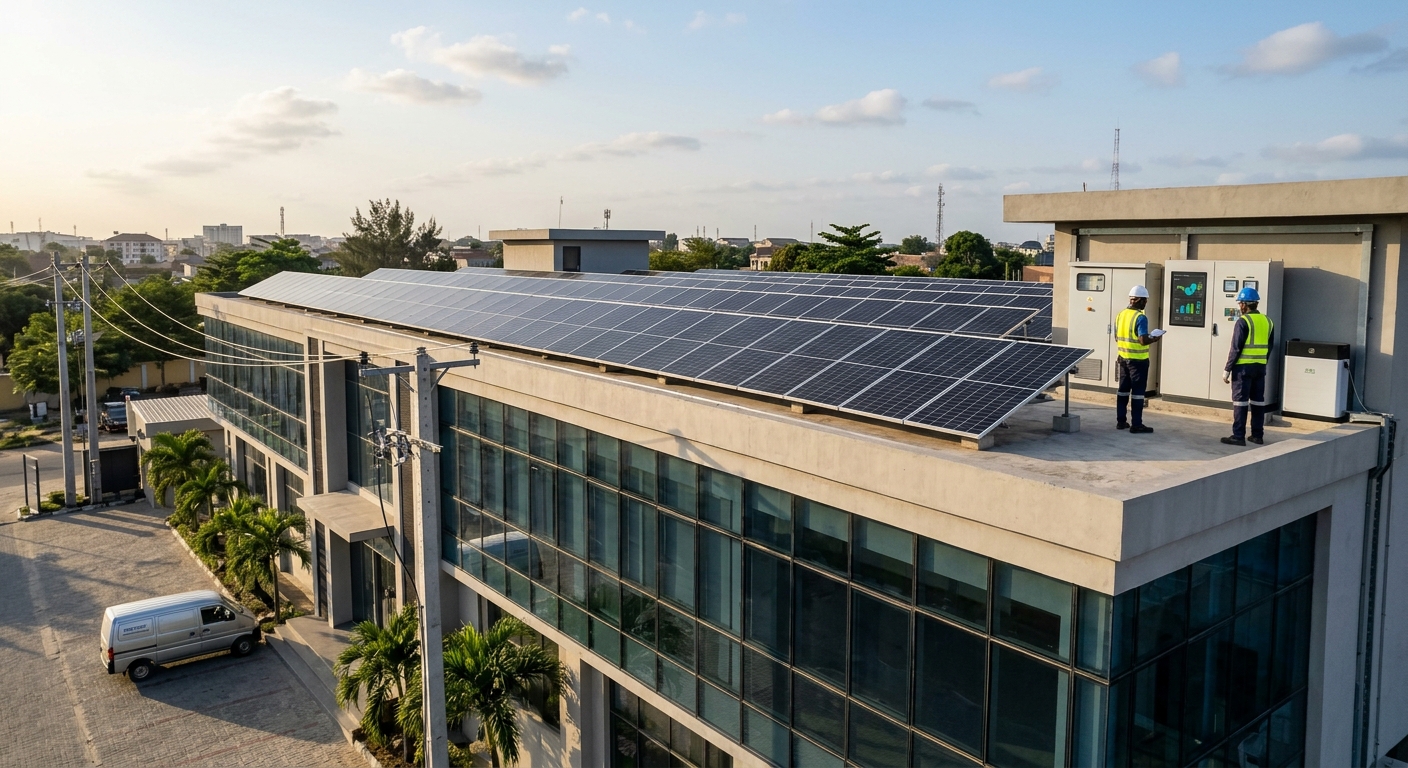
Nigeria’s unreliable electricity supply and rising energy costs are making power infrastructure a critical consideration for commercial property development. Office complexes, hotels, shopping centres, warehouses and mixed-use buildings must increasingly balance electricity tariffs, diesel expenses, operational reliability and long-term energy investment.
For developers, the challenge is not simply securing power. It is designing an energy system that delivers reliable electricity at a sustainable cost throughout the building’s operational life.
Understanding the True Cost of Commercial Power
Commercial electricity expenditure extends beyond the monthly utility bill. Depending on the building, major cost components include:
Grid electricity: Tariffs depend on the applicable distribution company, customer classification, tariff structure, and service arrangement. Developers should verify current rates and supply commitments before finalising operating-cost projections. The Nigerian Electricity Regulatory Commission (NERC) provides guidance on electricity tariffs.
Diesel generation: Costs include fuel, generator servicing, lubricants, repairs, and replacement of equipment. Actual generation cost depends on fuel prices, generator efficiency, loading, and maintenance.
Solar photovoltaic (PV): Solar systems require upfront investment in panels, inverters, mounting structures, protection equipment, and installation. Their economics depend on usable generation, system losses, maintenance and financing costs.
Battery energy storage: Batteries can support critical loads, store surplus solar generation and reduce generator runtime. Their value depends on storage capacity, usable energy, charging opportunities, efficiency and replacement costs.
Distribution infrastructure: Transformers, switchgear, cabling, changeover systems and electrical protection must be properly sized and integrated to ensure safe and reliable operation.
A credible feasibility assessment should compare the total cost of ownership of each option rather than focusing solely on the initial installation price.
Integrating Grid, Solar, Batteries and Generators
A hybrid energy system combines two or more power sources to improve reliability and manage operating costs.
For many commercial buildings, a practical configuration includes:
1. Grid electricity as the primary source: Where supply is dependable and commercially viable, the grid can provide a substantial share of the building’s electricity.
2. Solar PV for daytime demand: Solar generation can offset grid consumption and reduce generator operation during suitable daylight hours.
3. Battery storage for critical loads: Batteries can support selected lighting, security systems, IT infrastructure, and other essential equipment during outages, subject to proper sizing.
4. Generators for extended outages and high-demand periods: Existing or new generators can provide backup when grid supply and available solar generation cannot meet demand.
The appropriate configuration depends on the building’s load profile, available roof area, operating hours, critical equipment, and required backup duration. Not every building needs a large battery installation, and solar generation alone cannot guarantee uninterrupted electricity.
Design Decisions That Determine Energy Costs
Energy planning should begin before electrical and mechanical designs are finalised.
Developers should commission a load assessment that distinguishes essential loads from non-essential loads, identifies peak demand and estimates daily and seasonal consumption. Air-conditioning, lifts, pumps, refrigeration and other major equipment can significantly influence system sizing.
The design team should also assess roof loading and usable solar area, ventilation for generators, battery-room safety, cable routes, electrical protection and integration with building management systems.
Early coordination can prevent expensive retrofits, oversized equipment, and incompatible systems.
Evaluating the Investment
Before committing capital, developers should compare alternative configurations using the same operating assumptions.
The assessment should include:
Initial capital expenditure and installation costs.
Annual grid electricity and generator fuel expenditure.
Generator servicing and equipment maintenance.
Battery replacement and inverter lifecycle costs.
Financing costs and foreign-exchange exposure for imported equipment.
Expected energy production, system degradation and downtime.
The cost of outages, including lost business and disrupted building operations.
Payback estimates should be based on the difference between the expected operating costs of the proposed system and the existing or alternative arrangement. Savings should not be assumed without a documented baseline.
Regulatory and Procurement Considerations
Developers considering captive generation, embedded power, shared electricity infrastructure or mini-grid arrangements should determine the applicable regulatory requirements before procurement.
Nigeria’s Electricity Act 2023 established a framework for electricity generation, distribution and state-level electricity markets. Applicable approvals depend on the system configuration, capacity, location and whether electricity is supplied exclusively to the property or to other customers. Developers should consult NERC or the relevant state regulator, as applicable.
Procurement should prioritise equipment compatibility, technical warranties, local maintenance support, spare-parts availability and supplier performance guarantees.
The Commercial Property Advantage
Energy infrastructure is increasingly a long-term operating-cost and business-continuity decision, not merely a construction expense.
Developers who integrate energy planning into the early design stages can make better-informed decisions about capital allocation, operating expenditure and resilience. The objective is not to eliminate every grid or fuel expense, but to establish the most economical and reliable combination of energy sources for the building’s actual requirements.